Showing posts with label news. Show all posts

Friday, January 27, 2012

Discussions on Development: The Right of Indigenous Communities to Hit the Airwaves

I read this article today, and it really upset me. So I wanted to share it.

What upsets me, is that there are people trying to make things better in Guatemala, people and organizations that go to great lengths to write and promote legislation that would create equality and fairness, and I'm not just talking about this specific issue--this is just one example.

These bills get introduced, and the Guatemalan congress completely fucks it up. Pardon the language.

Why do they have to be so damn corrupt? Why can't they help Guatemala change, for the better? Why can't they promote safety and equality? Why can't they care about anyone but themselves and the interestes that are lining their pockets?

What would be so terrible about indigenous communities having community radio stations where they can empower women, promote education and awareness? Ok, that's a dumb question: if you educated indigenous communities, you wouldn't be able to keep them down. I get it.

This is the exact reason why Carlos Castresana resigned from the CICIG in 2010: the government's inability to act and cooperate with proposed laws that would strengthen the rule of law and help combat the corruption and impunity that reign in Guatemala (for a country with one of the highest murder rates per capita, it has a 2% prosecution rate--prosecution, not conviction). The government's response to his resignation? "Sometimes were are limited, legally, or in respect of governance or financing in how we can respond to their requests." Bullshit.

Related articles (to the CICIG and Carlos Castresana):

Thursday, September 22, 2011

Cristina and the Barreda syndrome

I apologize if my repeated posts about this woman are boring or uninteresting to some, but I truly believe that her story is worth writing about, or in my case, translating about. I think this case has brought Guatemala to a crossroad, and there are some exceptional women in that country who are trying to make sure they make the right turn, by not keeping silent. There are a couple blogs from the original writer who brought us this story that I have been wanting to translate, but they take more time in skill due to her exceptional writing, so they will come with time. But today, I came across the following opinion piece, and felt is was worth translating and sharing. The subject is something that I've wanted to blog about for over a year, and I just haven't made the time to do so: why are women in our culture (by "our" I mean Hispanic) so frequently victims of domestic violence? And why do they remain in relationships marred by domestic violence? As a volunteer with several legal nonprofits, I have worked with women who were victims of domestic violence in order to help them apply for immigration relief (through VAWA and U-Visa petitions), and the degree and frequency of violence that so many of these women put up with has always scared me. Alas, I should save my "opinion" piece for my own blog entry...

The Robert Barreda Syndrome

(As published on September 22, 2011, in El Periodico)

In Guatemala, things have to change and the aggressors have to know that their only place is in jail.

Sylvia Gereda Valenzuela

Since 2001 I have worked and investigated the subject of femicide and aggression against women in Guatemala. I find it interesting that we have such an aggressive male population, that has caused more than 6 thousand women to die in the most cruel ways: tortured, severed in their private parts, raped, and mutilated.

In those days, Ciudad Juarez was a site of murders that moved the world. Ten years later, Guatemala left Mexico behind.

I got to know the case of Mindi Rodas, the woman who’s husband ripped off her face, nose and mouth with a knife and after a long battle for justice was murdered.

I got to know the case of Claudina Vasquez, a young woman who was going to be an attorney, that was first raped and then put on her knees to die with a bullet to the temple.

Towards the middle of this decade, while I was going through my masters in sociology, I completed a thesis about femicides in Guatemala, and then I had to course through the morgues, see puddles of blood that wet my shoes, the bodies of dozens of women that arrived cut in pieces and their faces bruised. That year, when I started my television project of Informe Especial (Special Report) on Canal Antigua, I decided to go back and check the pulse of this silent drama. I didn’t even have to take a step to realize that the problem had surpassed us.

In July I started to investigate the disappearance and murder of Cristina Siekavizza, where the principal suspect is her husband Roberto Barreda. A story already known by everyone, but where the aggregate of influence peddling, abuse of power by Barreda’s parents, Beatriz De Leon and Roberto Barreda, has been an important factor in keeping this case without any punishment and allowing the two minors to disappear along with their psychopath father, according to those who have declared to know the case: the judge Veronica Galicia and Norma Cruz.

I have found myself with more than three dozen messages and letters from women commenting that the story of Cristina has made them understand the dangerous drama in which they are submerged. Many, for the first time, seeing the criminal extremes that Barreda allegedly reached, are daring to break the cycle of violence and raise their voice.

“My sister that was married for 33 years with a psychopath, controlling and feticidal that followed her with a gun, hit her, etcetera. Today she has separated from him and she is getting fucked over. He left her in the street, even though he has millions in accounts in the United States and he uses his best friend as a figurehead. She gave him her whole life, since she was 19, she never finished her career nor did she ever work. He told her that he was never going to giver her anything, over his dead body.”

“He would get home late, drunk, aggressive, he would smack me around.”

“He left with some girl that was 20 years younger than him, got her pregnant. When I confronted him about it he grabbed me and hit me, he slapped me and insulted me.”

“I knew that he lived in bars and whore houses. On three opportunities he transmitted venereal diseases to me. He would threaten me that if I left him he would leave me in the street and ruin me forever, I have never worked.”

Norma Cruz, president of the Fundacion Sobrevivientes (Survivors Foundation), told me on one occasion that Guatemalan woman has started to talk about what she called the “Barreda Syndome,” many of the attacked women are seeing in Roberto Barreda, a man that appeared to not be aggressive but that was a despot at home, their own husbands. En the case of Barreda, nobody saw the alleged murderer of his spouse coming. But when everyone reacted, Cristina had ceased to exist and her children had disappeared.

I have always believed that we all came into this world with a mission, that no life is in vain, just like no death is in vain. Cristina has moved more hearts and sentiments with her death than she did with her life, this is a sign that her spirit continues still today and it can be the point of inspiration so that many women who have been attacked start to talk and ask for help from prosecutors, support groups, or organizations in defense of women.

For my part, these stories of terror that have hit so many guatemalan women hurt me to my core, and they motivate me to commit myself with what I will soon start as a new life project, to save thousands of women, teenagers, and girls who are victims of violence. If I can be sure of something, it’s that today, more than ever, I will not lower my voice and I ask the women that they don’t either. In Guatemala, things have to change, and the aggressors have to know that their only place is in jail.

Sunday, November 14, 2010

Guatemala Update

A subject I have frequently written about is the Commission Against Impunity in Guatemala. I read a great article about it in the Washington Post today.

It was great to see the Washington Post write a long and thorough article on something that isn't in the news much, and that no mainstream media has much of an interest for.

As usual with Guatemala, it's depressing to see opposition to something that can actually help with the level of crime and impunity that exist within it. The CICIG has been facing opposition from various sectors since the very beginning, and I'm sure it will continue to face opposition for the remainder of its days. It just makes me sad.

It makes me sad because I read posts from my friend Isabel, who lives in Guatemala, and she talks about her frustrations with the crime and violence in Guatemala. People shut themselves in their house by 8pm. Their crime rate, as mentioned in the article, is three times that of Mexico. Three times. The crime rate of Mexico. Let that sink in for a bit.

So here's an organization that is fighting corruption and crime, and trying to prosecute those before thought to be untouchable because of their political influence and/or wealth. But it has to fight to survive.

I hope the two year extension of the CICIG is granted, and I hope it continues to provide meaningful improvements to the government of Guatemala. I hope the people of Guatemala demand it, should anyone stand in the way.

Saturday, June 5, 2010

Guatemala News Updates


The last couple weeks have been a little rough in Guatemala. It started when the Volcan Pacaya started erupting a leeeeeeettle more aggressively that normal, and began spewing ash all over the city and surrounding areas. If I'm not mistaken, this may be the same volcano that my family and I hiked up to on Christmas Day back in 2007. Pacaya has been an active volcano for quite some time, but it's been a little over ten years since it was this active.
Next came tropical storm Agatha, which has killed around two hundred people in the Central American region, and left over 150,000 people homeless. The storm caused several mudslides, as well as the overflowing of several rivers, the destruction of bridges around the area, and has left some small villages inaccessible. The people that I've talked to from Guatemala haven't been severely affected, thankfully. My grandma has been back here in the US for a while, so it's a relief not to have to worry about her safety. Apparently one of her renters had to move to the downstairs apartment, since the weight of the ash and water started causing several leaks in the apartment. My heart goes out to the hundreds that have been affected by it, however, and will continue to be affected by it until they get the help they need to reconstruct their homes and get back on their feet. The UN already issued a statement on aid it will be disbursing.


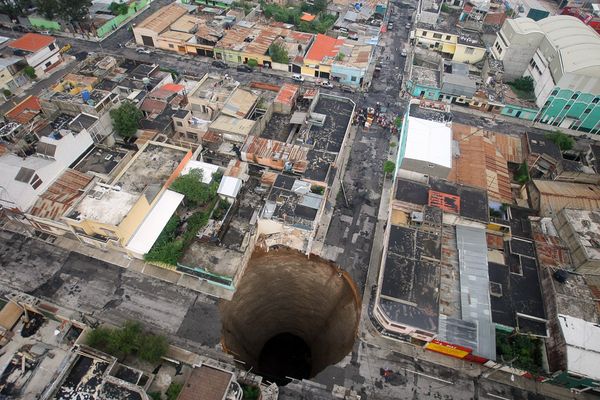
Finally, most of you have probably already heard about the giant sinkhole that opened up in the city. When this picture first came out on the web, there were rumors that it had been photoshopped. Nope. It's real. It's approximately 60 feet wide, and 300 hundred feet deep. 300 feet! Apparently that's large enough to swallow a three story building, and leave absolutely no sight of it. Thankfully, most reports are that there were no fatalities, since all workers had left the building for the day.

There was a similar sinkhole in Guatemala, in the same neighborhood I believe, about a year or two ago. I started doing a little research this morning into sinkholes, since I just can't fathom how they happen. I just post the link to Wikipedia instead of boring you all with what I've learned about them :) I still don't understand how they are in almost perfectly round shape, so if anyone comes across that information, please let me know.


I'm posting a link to a blog that I read on the regular, a Canadian mom living in Antigua, Guatemala. She has captured a lot of pictures of what's going on down there, as well as relief efforts in her neck of the woods.

Monday, May 31, 2010

Update on "Justice or Injustice?"

Some of you may remember a prior blog entry on a father's lawsuit against the church that protested his son's funeral. In turns out that 48 of 50 state attorney general's agree with the father, and have filed amicus brief's in support of the father. If you're interested in the full update, click here.

Saturday, January 30, 2010

News Updates

Ok, I was going to write separate entries for these, but thought that might be a little over the top, so I'm just going to mix them all in one blog; I leave it up to each of you if you want to follow the links for more information. The first link is my original blog post, the second is the updated link :)

1) Honduras. The ousted president is finally leaving his hiding in the Brazilian Embassy and says he is leaving the country. I think after four months he finally got the message that he's not going to be reinstated.

2) The suspects in the murder of Attorney Rosenberg are being put on trial. We'll see if they ever get a conviction.

3) This one's completely new. Since the CICIG began, one of the issues it was tackling was charging ex-president Alfonso Portillo for money laundering. Like probably most Guatemalan presidents, Portillo had prepared his post-presidency life by stashing away at least $6.5 million through American banks. There were claims that some of this money came from funds that were supposed to provide snacks to children in the public school system, as well as from the defense budget and who knows where else. Anyhow, the CICG tried as much as it could, but Portillo's legal team kept objecting and interfering with the CICIG's attempts to move the legal process forward. Portillo's extradition to Guatemala from Mexico was first requested in 2005, and the CICIG joined the proceedings in 2009.

Now things got a little more complicated. The US issued an arrest warrant for Portillo this month, since the money laundering was done through US banks, and he was actually arrested before trying to flee the country. The issue now is where Portillo will stand for trial. Although Portillo initially argued he fled Guatemala to Mexico because he could not get a fair trial there, his legal team is now claiming that he cannot be extradited to the US to stand trial because he is currently facing prosecution in Guatemala. Huh. Furthermore, there are allegations by Portillo that the arrest warrant was not property issued because Mexico did not provide the necessary consent, since they were the ones that originally granted his extradition to Guatemala.

Phew. Quite a mess, huh? We'll see what-if anything-happens with this one.

Sunday, January 17, 2010

Guatemala: Suicide or Murder?

Back in May, 2009, the country of Guatemala was pushed into a social and political crisis: an attorney by the name of Rodrigo Rosenberg had been killed while riding his bicycle. Days after his alleged murder, a video surfaced in which Rosenberg stated that if he was dead, it was because the president of Guatemala, Alvaro Colom (among others), had ordered his death. The details are pretty intricate, but the main facts are that Rosenberg had been dating a woman, Marjorie Musa, who was killed along with her father. Rosenberg was allegedly investigating their murder, and in his video he stated this was one of the reasons why the President and others wanted him killed.

Needless to say, the country went into a downward spiral of chaos. People protested, vigils were had, Facebook groups were created, the President was asked to step down, etc., etc. As all things in Guatemala, things calmed down after a few weeks and not much was heard after. The Guatemala Commission Against Impunity ("CICIG") was now in charge of the investigation, and was promising to bring justice and transparency. The CICIG was created a couple years ago, and is a joint enterprise between the United Nations and Guatemala to try and combat impunity, largely by having an investigatory body that is not affiliated with the country of Guatemala, and thus less susceptible to corruption. Indeed, the head of the organization, Carlos Castresana, hails from Spain, and many within the organization come from a variety of other countries. Thus far, the CICIG had been steadfast in changing legislation and recommending crucial changes to the judicial system. Although it has tried to implement change, it has constantly had to go on an all-out war to achieve anything, since most people who have to approve anything this commission does are happy with the way things are done in Guatemala. Up until recently, the people of Guatemala were generally optimistic and hopeful about the presence of the CICIG and the work it was doing.

However, the CICIG has recently lost much credibility within the Guatemalan public. This is because they recently reported their findings on the Rosenberg case, in which they stated that Rosenberg set up the assassination himself--orchestrating his own death. This news even made it to the New York Times. I checked out the CICIG's website (which for my luck was not in existence when I was writing a research paper on the commission!), and found a powerpoint presentation on their findings. Granted, it's all in Spanish, but they seem to have done quite a bit of homework to come to their conclusion. I honestly don't know who to believe. The report states that Rosenberg was depressed because of the murder of his girlfriend, and because his wife was threatening to take away visitation of their children. Granted, some people get so depressed they decide to kills themselves, but to go the extra mile and orchestrate your own assassination to involve the President of the country, with a plot that was pretty intricate and involved at least a dozen different people? It's hard to believe. I think Rosenberg would have had to have some strong feelings against the President in order to give his own life to bring the President down.

I applaud the CICIG for actually doing an investigation, which is a step further than Guatemala would have done without the CICIG, but I still wonder if the investigation has any merit to it.

Sunday, November 15, 2009

Thoughts on Honduras, anyone?

Personally, I'm kind of excited that someone had the balls to stand up to a president who started trying to be the next Hugo Chavez. I know the international community is technically opposed to the coup, but I wonder if it's just to save face: they have to be opposed to a coup. A coup isn't the greatest example of a well run democracy, and what democratic nation (or organization) would want to publicly endorse a coup?

Here's my thought: it was a good move. Zelaya was wanting to impose new constitutional reforms to stay in power, probably not unlike those that Chavez has "proposed" and keeps succeeding at. So the government took it upon itself to take action. The military, congress, and supreme court were all in agreement before the coup happened. I'm not saying it was the best course of action, but it was better than no course of action. The international community needs to be less concerned with saving face, and more concerned with preserving the democratic institutions that already exist. I hope the elections coming up at the end of the month will be given full legitimacy by the international community, with our without Zelaya.